How I Approach System Design Interviews 🏗️
Aarav Sharma
Senior Backend Engineer @ Paylane | Java, Spring Boot, Kafka | Building payment rails that don't wake you up at 3am
How I Approach System Design Interviews 🏗️
One thing I’ve learned about system design: it’s not about choosing the most advanced technology. It’s about making the right trade-offs.
When I approach a system design interview, I follow a structured process:
🔹 1. Understand the Requirements:- Clarify what the system needs to do and identify functional and non-functional requirements.
🔹 2. Estimate the Scale:- Think about expected users, request volume, data storage, and traffic growth.
🔹 3. Design the APIs and Data Model:- Define how services communicate and how data will be stored, accessed, and updated.
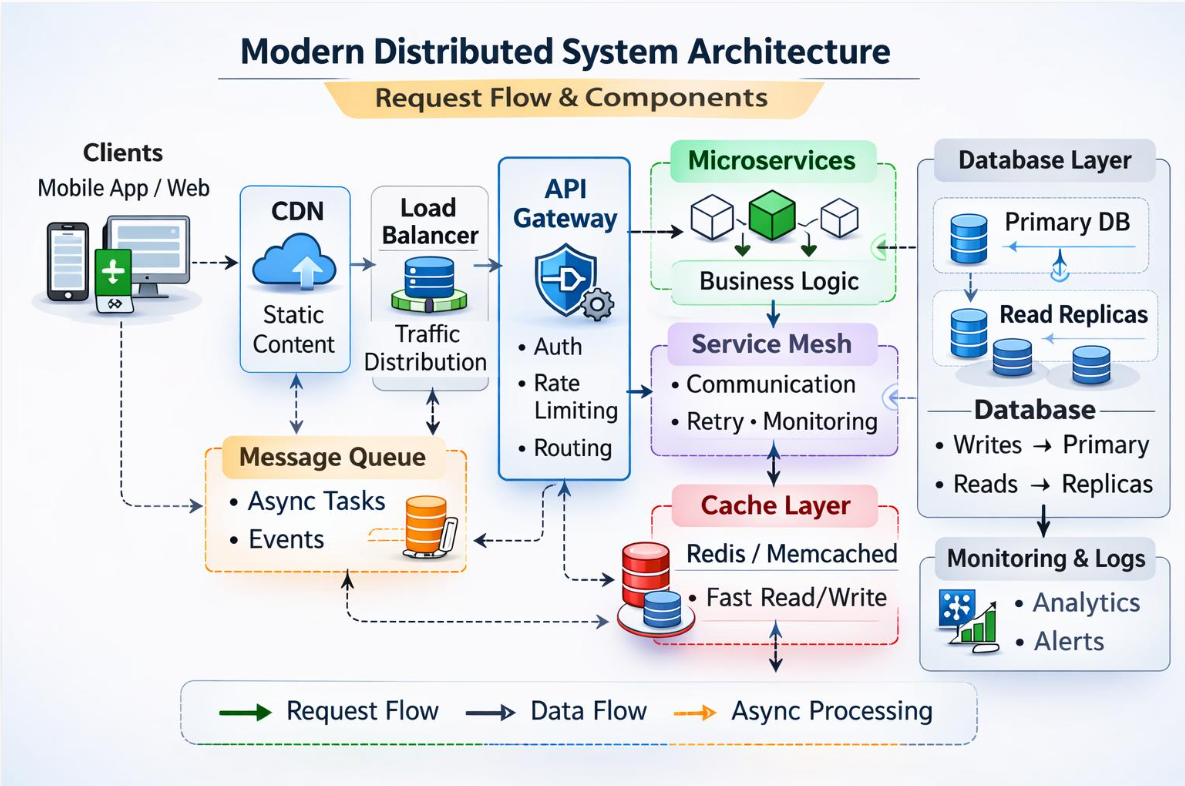
🔹 4. Build the High-Level Architecture:- Identify the main components and decide where databases, caches, queues, and services fit.
🔹 5. Think About Failures:- What happens when a service goes down? How do we handle retries, duplicate requests, and traffic spikes?
🔹 6. Discuss Trade-offs:- Every design has trade-offs. The goal is to explain why a particular approach makes sense for the problem.
Working with backend systems, especially payment infrastructure, has reinforced one important lesson: reliability, idempotency, and observability should be part of the design—not an afterthought.
A good system design isn't the most complicated one. It's the one that solves the problem reliably and can evolve as requirements change.
💬 Question for fellow developers: What's the first thing you focus on when starting a system design interview?
#systemdesign#softwareengineering#java#backenddevelopment#systemarchitecture