
Most AI applications today can generate text, write code, summarize information, or answer questions.
Happy Yadav
Software Developer | Node.js | React.js| Next.js|AWS|GCP
Most AI applications today can generate text, write code, summarize information, or answer questions.
But what happens when AI can actually take action?
That’s where AI Agents come in.
🧠 What is an AI Agent?
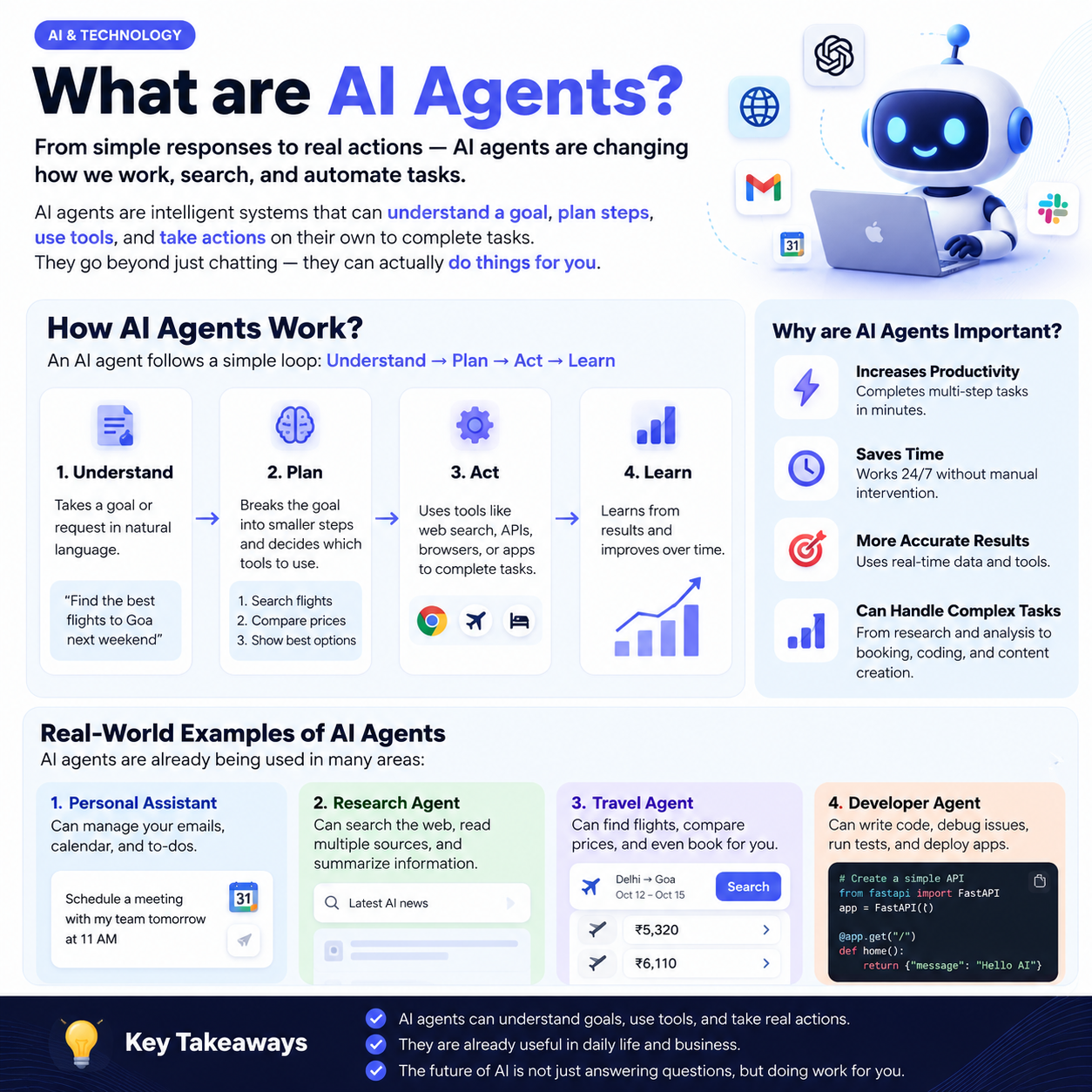
An AI agent is a software system that can:
Understand → Plan → Use Tools → Act → Observe → Repeat
Instead of simply responding to a prompt, an agent can break a goal into multiple steps and execute them using external tools.
For example:
“Find the best flight to Goa for next weekend and prepare the itinerary.”
A traditional chatbot might tell you how to search for flights.
An AI agent could potentially:
Understand the requirements
Search the web
Compare available flights
Check prices
Create an itinerary
Present the results
⚙️ The Technical Architecture
A basic AI agent can be built around several components:
LLM / Reasoning Model
↓
Planner / Decision Maker
↓
Tool Calling
↓
Environment / APIs
↓
Observation
↓
Memory / State
↓
Next Action
The LLM acts as the reasoning engine, while tools allow the agent to interact with the outside world.
Tools can include:
🌐 Web browsers
🔌 REST APIs
🗄️ Databases
💻 Code execution
📧 Email
📅 Calendars
🔎 Search engines
🐳 Containers
☁️ Cloud services
🔄 Agent Loop
A simplified agent might work like this:
User Goal
↓
Understand Goal
↓
Create Plan
↓
Select Tool
↓
Execute Action
↓
Observe Result
↓
Evaluate
↓
Next Action
↓
Final Result
This loop is what makes agents fundamentally different from a simple question-answering chatbot.
🚀 Where AI Agents Can Be Used
Developer Agents
Read code → identify bug → modify code → run tests → fix failures.
Research Agents
Search multiple sources → extract information → compare findings → generate a report.
Customer Support Agents
Understand request → retrieve customer data → call APIs → resolve the issue → respond.
#ai#ml#tech#llm
4 reactions