Vivaan Patel
Frontend Engineer | React, Next.js, TypeScript | Obsessed with fast, accessible UIs
1/2
Vivaan Patel
Frontend Engineer | React, Next.js, TypeScript | Obsessed with fast, accessible UIs
Vivaan Patel
Frontend Engineer | React, Next.js, TypeScript | Obsessed with fast, accessible UIs
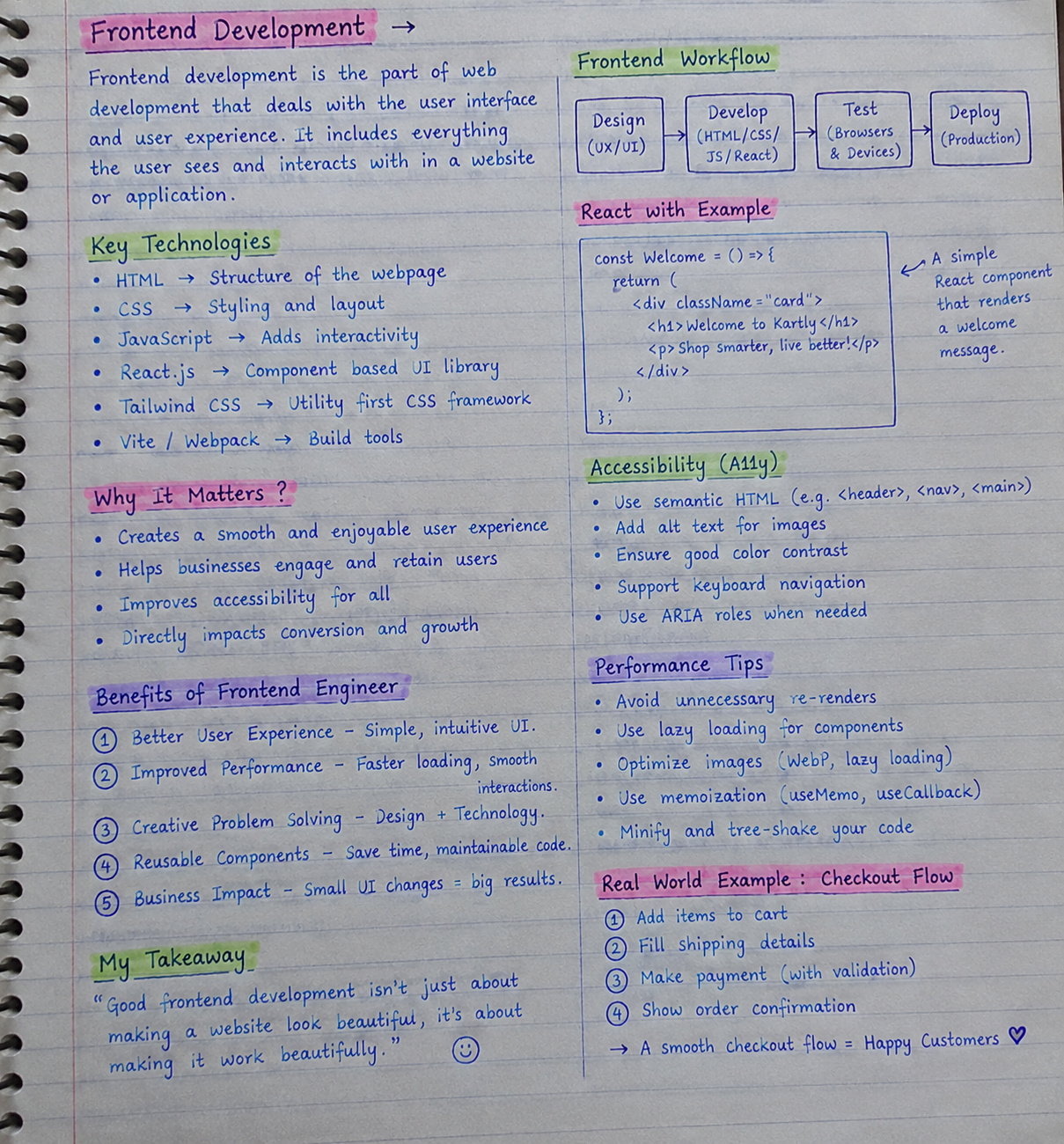
Why Frontend Engineering Matters!
A great application isn't just about what happens behind the scenes — it's also about how people experience it.
As a Frontend Engineer, I believe our role is to turn ideas into interactive, accessible, and user-friendly experiences.
5 Key Benefits of Frontend Engineering:
Better User Experience: Create interfaces that are simple, intuitive, and easy to navigate.
Improved Performance: Optimize React components and loading times for smoother interactions.
Creative Problem-Solving: Combine design and technology to solve real user problems.
Reusable Design Systems: Build consistent UI components that save development time.
Real Business Impact: Small improvements in checkout flows, forms, and navigation can make a big difference to users.
My takeaway: Good frontend development isn't just about making a website look beautiful. It's about making it work beautifully.
What's more important to you in frontend development: performance, design, or accessibility?
Life of a Product Manager: The Feature That Never Ends!
Me: “We've finalized the requirements.” 😎
Developer: “Development is complete.” 💻
QA: “Found 12 bugs.” 🐛
Me: “Okay, let's fix them before launch.”
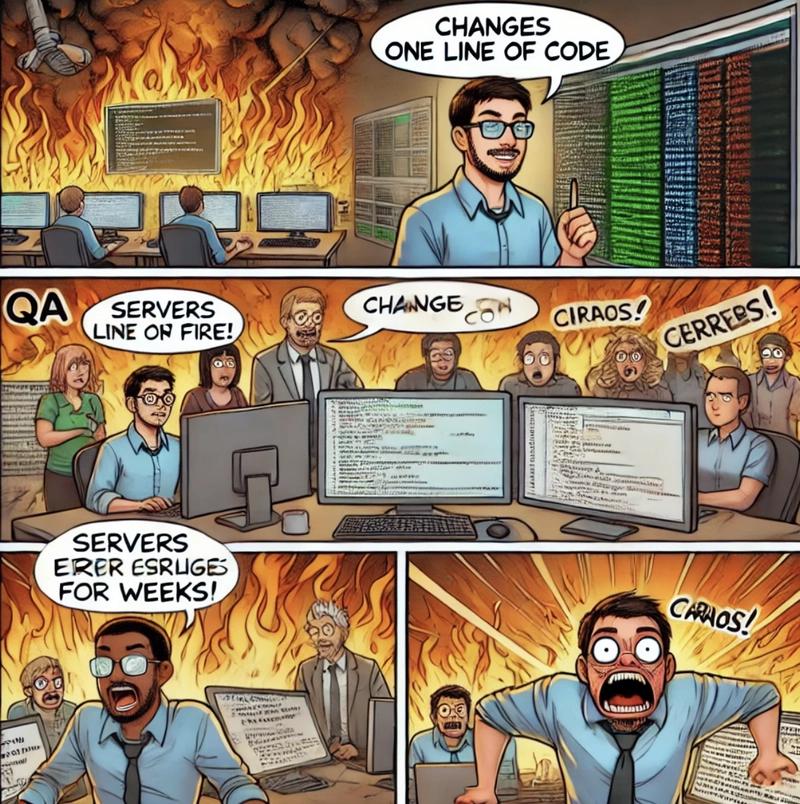
Stakeholder: “Can we add just ONE small feature?” 🙂
Me: “Sure… when do you need it?”
Stakeholder: “Yesterday.” 💀😂
Meanwhile, the roadmap is crying, the sprint is overloaded, and my coffee has gone cold. ☕😭
Product management is basically turning ‘just one small change’ into a 3-page PRD, 2 meetings, and 15 Slack messages! 🤣
Fellow PMs, what's your most frequently heard sentence?
“It's a quick change.”
“Can we launch it today?”
“Let's align on this.”
“Why wasn't this included in the scope?” 😂
Aarav Sharma
Senior Backend Engineer @ Paylane | Java, Spring Boot, Kafka | Building payment rails that don't wake you up at 3am

Aarav Sharma
Senior Backend Engineer @ Paylane | Java, Spring Boot, Kafka | Building payment rails that don't wake you up at 3am
From Junior to Senior: Let’s Grow Together in Java!
Being a Java developer is more than writing code. It's about solving problems, learning from failures, and building reliable applications.
Here are a few topics every Java developer should explore:
Spring Boot: Build scalable REST APIs and microservices.
JPA & Hibernate: Understand database relationships and optimize queries.
Kafka: Learn how services communicate through event-driven architecture.
JVM Tuning: Improve application performance and understand memory management.
Clean Code: Write code that your teammates can understand and maintain.
You don't need to know everything to be a great developer. You just need to keep learning and be willing to help others.
🇮🇳 Let's build a strong Java and Spring community across India! Share your projects, ask questions, discuss real-world challenges, and help fellow developers grow from junior to senior.
Question for the community: What's one Spring Boot issue that took you hours to debug but taught you something valuable?
Aarav Sharma
Senior Backend Engineer @ Paylane | Java, Spring Boot, Kafka | Building payment rails that don't wake you up at 3am
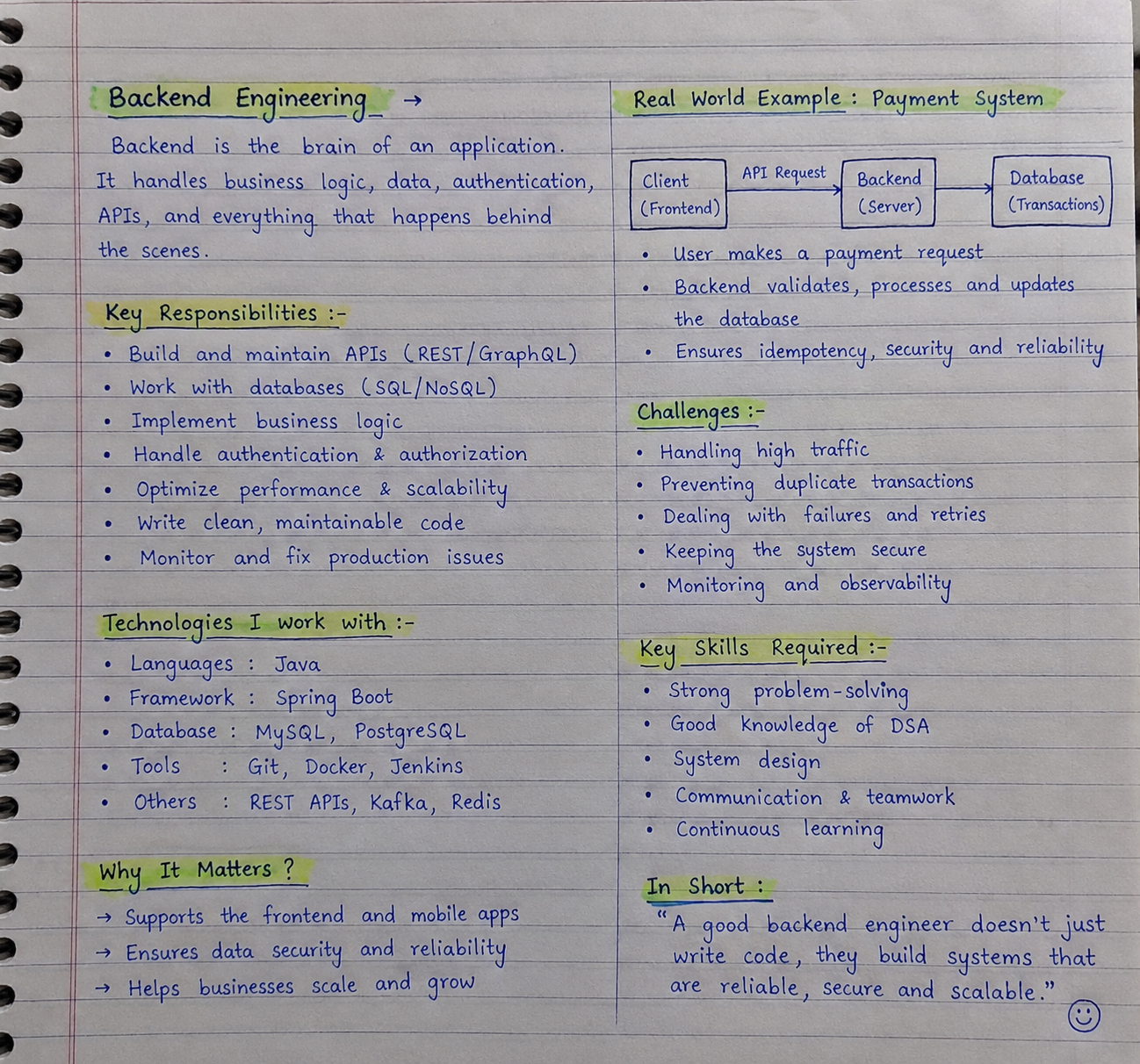
Why Senior Backend Engineers Are So Important
A reliable backend is the foundation of every successful application. As a Senior Backend Engineer working on payment infrastructure, I’ve learned that building systems that work consistently is just as important as building new features.
Here are 5 key benefits of strong backend engineering:
1. Reliable Payments: Idempotency helps prevent duplicate transactions when requests are retried.
2. Better Performance: Efficient APIs and database queries make applications faster and smoother.
3. Improved Observability: Logs, metrics, and alerts help teams identify and resolve issues quickly.
4. Scalable Systems: Well-designed architecture helps applications handle increasing traffic and business growth.
5. Knowledge Sharing: Mentoring developers and sharing best practices help the entire engineering team grow.
My biggest takeaway: Great backend engineering isn't just about making things work. It's about making them reliable, observable, and easy to maintain.
What matters most to you in backend development: reliability, scalability, or performance?
Ananya Rao
Product Designer @ Kartly | UX research, design systems | Making complex flows feel simple
A Product Designer's Daily Struggle
Me: “I've made the design simple and user-friendly.”
Developer: “This isn't possible to build in two days.” 😭
Product Manager: “Can we add just one more feature?”
Client: “Can you make it pop?” 🤔
User: “I don't understand where to click.” 💀
Me: Opens Figma again and moves a button 2 pixels to the left. 😂
After 17 revisions, 4 meetings, and 3 cups of coffee…
Everyone says: “Wow, it's so simple!” 🤡
Meanwhile, nobody knows how much work went into making it simple. ☕🤣
Designers, what's the most confusing feedback you've ever received?
Dhruv Joshi
Software Developer | Java, Spring Boot, React | Learning system design one outage at a time
Happy
Nvidia just showed off their new robots.
Honestly, watching machines learn to walk and handle objects so smoothly is pretty wild. We are getting closer to seeing these in actual warehouses and everyday environments sooner than expected.
What do you think about this rapid progress in robotics?

Your LLM Sounds Confident. But Is It Actually Correct?
One of the biggest challenges in building Generative AI applications is that an LLM can produce a convincing answer that is factually incorrect.
In production, a fluent response isn't necessarily a trustworthy response.
Here are 5 practical ways to improve LLM reliability:
1. Ground Answers in Trusted Data
Use Retrieval-Augmented Generation (RAG) to provide relevant context from reliable sources.
2. Improve Retrieval Quality
Experiment with chunk sizes, metadata filters, hybrid search, and reranking to retrieve more relevant information.
3. Give Clear Instructions
Define what the model should do when information is missing, ambiguous, or unsupported by the available context.
4. Evaluate With Real Examples
Build a test dataset containing normal questions, edge cases, and questions that cannot be answered from your documents.
5. Measure More Than Accuracy
Track faithfulness, retrieval relevance, latency, cost, and how often the system correctly abstains when it lacks sufficient evidence.
An important lesson: Adding more context doesn't automatically make an AI system better. The quality of that context and the way you evaluate results matter just as much.
Building reliable AI isn't about eliminating every possible mistake. It's about measuring failures, reducing risks, and making the system's limitations clear.
AI engineers: What's worked best for you when improving LLM reliability — better retrieval, stronger evaluation, or prompt engineering?